
Research
Purpose, scale and power: expanding the role of community benefits for the energy transition
This article brings a place-based, community-led perspective to the challenge of building renewable energy. It reviews the global literature on community benefit sharing using the relational method to identify a way forward. that navigates the demands of climate change and the needs of affected communities.
By Claire Parfitt & Amanda Tattersall
Summary:
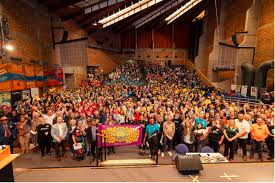
This article brings a place-based, community-led perspective to the challenge of building renewable energy. It reviews the global literature on community benefit sharing and uses the relational method to identify a way forward. that navigates the demands of climate change and the needs of affected communities. The image is of Hunter Community Alliance, one of five place-based partners involved in the Real Deal for Australia project.
This is a peer reviewed open access academic article published in Energy Research and Social Science (November 2026), and the abstract is below.
Abstract
The energy transition is neither proceeding as rapidly, nor as widely, as required to meet global climate policy goals. Moreover, the energy transition is under pressure due to rising far right political movements which frame the economic shifts required as a threat to livelihoods. One strategy for generating support for renewable energy development has been the distribution of “benefits” by project proponents. In this critical review, we explore the literature on benefit sharing in distinct contexts: energy projects, urban infrastructure and the extractive industry. Reading the literature through a theoretical lens that centres community engagement, power relations and social provisioning economic theory, we argue that prevailing approaches to benefit sharing for the energy transition are too narrow. We propose three changes that constitute a new point of departure for benefit sharing in the energy transition. First, we expand the scale of benefit sharing from project to recognise that the scale of the energy transition impacts not only the immediate and local area but the economy as a whole. This demands that we query not only the scale, but also the objective of benefit sharing. Existing benefit sharing practice often adopts a compensatory aim. We argue instead that the purpose of benefit sharing, should be broad-based, redistributive and prioritise agency for community parties. This reorientation demands that “the community” be actively and consciously constructed, rather than assumed. Finally, community parties must be properly resourced to participate in the process – financially, organisationally and through regulatory structures – to support their bargaining power.
Citation:
Parfitt, Claire., Tattersall Amanda. Purpose, scale and power: expanding the role of community benefits for the energy transition. Energy Research and Social Science, 141, 105027.
More work

How do we build power in coalition? Rethinking union-community coalition types 12 years on.
This is article is an invited contribution based on a piece about coalition building first published in this…

Democratising Cities: introduction (special feature)
This is an introduction to a peer-reviewed special feature in the journal City. This piece provides a theorisation…

Prefiguring Pragmatically? Prefigurative Politics and the Constellation of People Power Strategies for Winning Affordable Housing in Cape Town.
This is an academic peer-reviewed article about the social change strategy called ‘prefiguration’ which is the practice of…